Drake, The Ice Man
Drake’s latest marketing stunt — a towering ice sculpture in downtown Toronto, wasn’t just a clever way to tease an album release. It was a strategically layered campaign that blended public art, cultural reference, and behavioural psychology into one of the most compelling activations we’ve seen in years.
At the centre of it all is Drake, an artist who understands that attention isn’t just captured, it’s engineered.
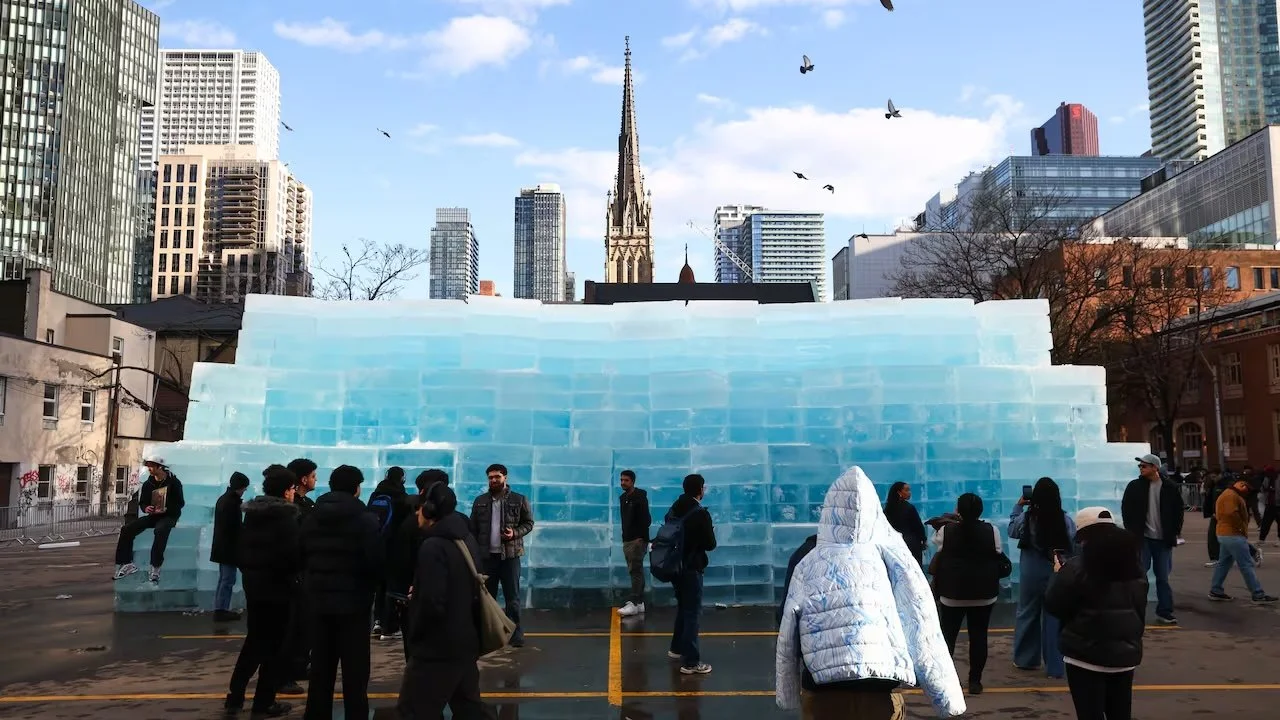
People gather around blocks of ice, installed in a Toronto parking lot as part of promotion for rapper Drake's upcoming album 'ICEMAN' on Monday, April 20, 2026. (Cole Burston/The Canadian Press)
More Than a Marketing Stunt
At face value, the concept was simple: a massive ice structure placed in the city, slowly melting to reveal a hidden message tied to his upcoming album Iceman. No countdown clock. No scheduled drop. Just time doing the work.
But simplicity is often where the most effective ideas live.
What set this apart wasn’t just the visual—it was the intention behind it. This wasn’t about a quick announcement or a flashy digital release. It was about building anticipation through time, presence, and physical space. In a marketing landscape dominated by immediacy, Drake chose to slow things down—and in doing so, made people lean in.
From a marketing lens, this taps into a powerful and underused lever: delayed gratification.
You couldn’t instantly access the information. You had to wait, revisit, or physically show up. That friction didn’t push people away—it created a loop of curiosity and return engagement, which is far more valuable than a one-time click.
The Art Reference That Elevated Everything
What separates this from a typical stunt is its conceptual depth.
The campaign strongly echoes Allan Kaprow’s Fluids — a 1967 series of temporary ice structures built across California. Kaprow was a pioneer of what he called “Happenings,” a form of art that prioritized experience over object. The focus wasn’t the final piece, but the act of creating it, witnessing it, and ultimately watching it disappear. These rectangular enclosures, made entirely of ice blocks, were designed to melt away: leaving nothing behind.
Drake’s sculpture mirrors this philosophy almost exactly.
Like Fluids, the installation was never meant to last. Its meaning existed in its impermanence. There was no product to take home, no artifact to preserve—just a moment unfolding in real time.
From a marketing standpoint, this adds a critical layer: cultural credibility.
This wasn’t just promotion—it was reference, intention, and creative continuity. Drake has even shared similar ice-based works years ago on his Instagram, suggesting this idea wasn’t reactive. It was a stored inspiration, executed at the right moment.
That’s the difference between a campaign that feels trendy and one that feels intentional, layered, and highly crafted.
Built for Toronto, Amplified Everywhere
Placing the installation in downtown Toronto wasn’t just a hometown nod—it was a strategic distribution decision.
Toronto became the primary touchpoint, but social media became the amplification engine. People visited, filmed, speculated, and shared. The installation acted as the source content, while platforms like TikTok and Instagram turned it into a global conversation.
No heavy paid push. No forced virality.
Just a strong enough idea that people wanted to document it.
Scarcity, Urgency, and Behaviour
Another reason this worked so well comes down to behavioural psychology—executed cleanly in a physical space.
Scarcity: The installation was temporary. Miss it, and it’s gone.
Uncertainty: No defined reveal moment kept people checking back.
Exclusivity: Being there in person felt like insider access.
The melting ice became a natural countdown—but without a clear endpoint. That ambiguity created tension: When will it melt? What’s inside? Should I go now?
That’s not passive awareness. That’s active engagement. Scarcity drove urgency. Urgency drove attention. Attention drove conversation.
Why This Worked (Through a Marketing Lens)
At its core, this campaign succeeded because it hit multiple strategic pillars at once:
Physical + Digital Integration: Real-world activation that scaled globally
Emotional Triggers: Curiosity, anticipation, and urgency
Cultural Depth: Artistic reference that elevated perception
Narrative Design: A campaign that evolved over time
Audience-Led Amplification: Built to be shared, not pushed
Most brands manage one or two of these. This hit all five seamlessly.
Final Takeaway
Drake’s ice sculpture, much like Fluids, was never about the structure itself. It was about what it set in motion.
The attention. The tension. The behaviour. The conversation.
That’s where this campaign wins.
For brands and agencies, the takeaway is sharper than ever: visibility alone isn’t enough. The work needs to create curiosity, invite interpretation, and give people a reason to keep coming back—not just once, but repeatedly.